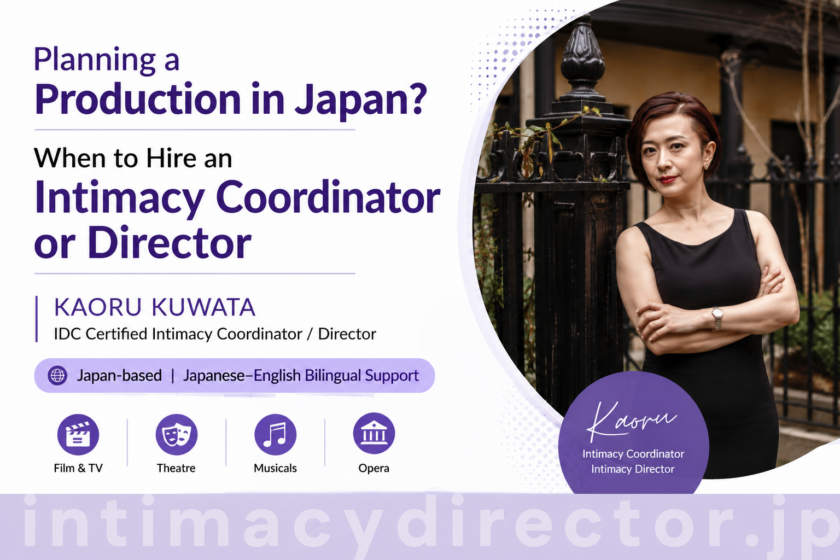
If you are planning a film, television, streaming, theatre, musical or opera production in Japan, the best time to discuss intimacy coordination is usually before rehearsals or filming begin.
Scenes involving kissing, nudity, partial exposure, simulated sexual content, underwear, swimwear, bathing, changing clothes, close physical contact or other physically sensitive action may require specialist support.
However, the question is not only whether a scene appears “intimate.”
The more useful production question is:
What will the performers actually be asked to do, what will the audience or camera see, and when should those details be clarified?
A bilingual Intimacy Coordinator or Intimacy Director in Japan can help translate a script and creative intention into information that performers and production departments can use in rehearsal, on set and in performance.
When should you hire an Intimacy Coordinator or Director in Japan?
An international production does not need to wait until every creative detail has been finalised.
It is often useful to contact an intimacy professional:
- during development or script review
- before casting notices or audition information are finalised
- before performers are approached about specific intimate action
- before costume, location and shot planning are locked
- before rehearsals begin
- before filming begins
- when a scene changes during pre-production
- when the production is unsure what level of support is required
Early consultation does not make the process heavier.
It gives the production more time to clarify the scene, communicate accurately and prepare the departments involved.
When the intimacy professional is contacted only after performers, costumes, locations and shot plans have been confirmed, the number of workable options may already be limited.
Why international productions in Japan need early communication
International productions often work across several layers of communication.
A director may be working from a script or treatment developed overseas. A Japanese production company may be arranging locations, schedules, performers, costumes and local crew. Some performers may work in Japanese, others in English, and important information may pass through producers, managers, agencies, translators or assistant directors.
Even when everyone is working carefully, a short line in a script can create several different interpretations.
For example:
- “They kiss passionately.”
- “He pulls her close.”
- “They wake up together.”
- “She changes clothes.”
- “The couple becomes intimate.”
- “They are seen bathing.”
These lines do not yet explain what will actually happen.
What kind of contact is expected?
Who initiates the movement?
Which parts of the body are involved?
How long does the action continue?
What will be visible to the camera or audience?
What costume, covering or modesty garment will be used?
How many times may the action be repeated?
What happens if the camera position, costume, location or direction changes?
These details affect performers, direction, costume, camera, lighting, scheduling and rehearsal.
They should not be discovered for the first time when the room is already full of people waiting to work.
Intimacy Coordinator or Intimacy Director: what is the difference?
An Intimacy Coordinator generally works in recorded media, including film, television, streaming series, commercials and other screen productions.
An Intimacy Director generally works in live performance, including theatre, musicals, opera and other stage-based productions.
Terminology and production structures may vary, but both roles require more than a list of questions.
The intimacy professional reads the script through a specialist lens, identifies the physical and production implications of the scene, clarifies what information is needed, and helps turn the creative intention into repeatable action.
This work may include script analysis, production consultation, performer communication, movement design, choreography, rehearsal support and attendance on set or in the rehearsal room.
Intimacy support is not limited to sex scenes
An Intimacy Coordinator or Director is not required only when a production includes explicit nudity or simulated sex.
Depending on the context, specialist support may also be relevant for scenes involving:
- kissing and romantic contact
- nudity or partial nudity
- underwear, swimwear or revealing costumes
- bathing, onsen, sauna or shower scenes
- changing clothes
- characters lying in bed together
- close bodily proximity
- touch involving the face, hair, chest, waist, hips or thighs
- carrying, restraining, holding, pushing or pulling
- physical contact within violent or emotionally intense scenes
- medical, care-related or vulnerability-based scenes
- scenes involving children or young performers
- camera framing that creates the appearance of more contact or exposure
The title of the scene does not determine whether support is needed.
What matters is the action performers are being asked to carry out, what will be visible, what has been communicated, and whether that action can be rehearsed and repeated under clearly understood conditions.
What can be clarified before casting, rehearsal or filming?
At the development, script or pre-production stage, an Intimacy Coordinator or Director may help clarify:
- which scenes contain intimate or physically sensitive action
- what contact is implied by the script
- what the director or stage director intends the audience to understand
- what performers need to know before accepting or preparing for the work
- what should be included in casting notices or audition information
- whether nudity, partial exposure or revealing costume is involved
- what costume solutions or modesty garments may be required
- what camera framing, lenses or stage sightlines may reveal
- whether the scene requires choreography or repeatable movement
- which departments need access to which information
- how changes will be confirmed and communicated
- whether rehearsal-room or on-set support is required
The aim is not to create more paperwork.
The aim is to make sure that the necessary information reaches the right people, in a form they can use, before the work becomes urgent.
A checklist alone does not replace professional judgement
A production may find a checklist of questions and reasonably think that a producer, director, assistant director, production manager or stage manager can ask them.
Knowing the questions, however, is not the same as performing the role.
The specialist decision-making begins before any question is asked.
An Intimacy Coordinator or Director reads the script, emails, casting information, costume notes, production plans and changes through a professional lens.
The work involves deciding:
- what needs to be clarified
- when it should be clarified
- who should be asked
- how the question should be framed
- where the conversation should take place
- who needs the resulting information
- what should be documented
- who will assess a later change
- how that change will be communicated across departments
This is comparable to other specialist roles in production.
A director does not become an action director simply by learning a list of action-safety questions. An assistant director does not become a fight director by reading the basic principles of stage combat.
Those roles require trained observation, practical judgement, movement knowledge, communication skills and the ability to respond to changing conditions.
Intimacy coordination and direction require the same recognition as specialist professions.
Why the intimacy role cannot be combined with another production role
The intimacy role cannot be combined with a role that directs, hires, evaluates, schedules, contracts or manages the performers involved.
This is not a judgement about anyone’s intentions, kindness or integrity.
It is a question of function, independence and the distribution of authority.
A director or stage director is responsible for artistic decisions.
A producer or production manager is responsible for budget, contracts, schedule and delivery.
An assistant director or stage manager is responsible for helping the day or rehearsal run efficiently.
If that same person also becomes responsible for checking intimate content, several kinds of authority gather in one place.
For a performer, the person asking the questions may also be the person giving the direction, controlling the schedule, influencing employment or asking the team to complete the scene quickly.
That changes the conditions in which the conversation takes place.
Separating the intimacy role also benefits the person who might otherwise be asked to combine the jobs.
A director should be able to concentrate on direction. A producer should be able to oversee the production. An assistant director or stage manager should be able to manage the room and the schedule.
When incompatible responsibilities are placed on the same person, the decision-making priorities become confused and both roles become harder to perform properly.
Hiring an independent intimacy professional allows each member of the production to remain focused on their original professional responsibility.
Why bilingual local support matters in Japan
Language is only one part of international production communication.
Literal translation may not clarify what performers will actually be asked to do.
An intimacy professional working in Japan may need to understand:
- the director’s creative intention
- the production hierarchy and communication routes
- Japanese rehearsal and filming practices
- how performers receive information through agencies or managers
- costume, camera and location requirements
- movement and choreography
- how changes will be discussed in Japanese and English
A phrase that sounds general in English may be understood more specifically in Japanese, or the reverse.
A costume note may reach one department but not another. A manager may receive information that has not yet been explained directly to the performer. A new camera angle may alter what is visible even though the script has not changed.
Bilingual intimacy support helps connect creative intention, performer information and practical production needs across languages.
What does an Intimacy Coordinator or Director do during production?
The scope depends on the project, but support may include:
- script or treatment review
- scene breakdown and risk identification
- consultation with producers, directors and stage directors
- pre-production and departmental meetings
- reviewing intimacy-related casting information
- performer conversations and preparation
- clarifying agreed conditions
- liaising with costume, camera, production and stage management
- designing or choreographing intimate movement
- supporting rehearsals
- attending filming or live-performance rehearsals
- checking changes against previously clarified conditions
- helping establish repeatable action
The role is not to take over the director’s work or reduce the artistic impact of a scene.
The role is to help translate the director’s intention into specific action that performers understand and the production can repeat.
What changes between the script and the day of production?
Script-stage clarification and on-set or rehearsal-room judgement are not the same task.
In screen production, the location, set, costume, camera position, lens, lighting, blocking, number of takes and direction may change.
In live performance, costume, set, stage dimensions, audience sightlines, casting combinations, choreography and tempo may develop during rehearsal or alter on tour.
Each change may appear small.
Together, however, they can change the level of contact, exposure, physical effort or visibility involved in the scene.
An intimacy professional compares what was previously clarified with what performers are now being asked to do.
That is why an early conversation does not automatically remove the need for rehearsal support or on-set attendance.
What the production gains by hiring early
Bringing in an Intimacy Coordinator or Director early can help the production achieve:
- clearer communication between creative and production departments
- more accurate information for performers
- fewer last-minute surprises
- better preparation for costume, camera, staging and rehearsal
- repeatable physical action
- clearer procedures when the scene changes
- less time spent resolving misunderstandings on the day
- more focused working time for directors and performers
- fewer avoidable stops, revisions and hurried decisions
Intimacy coordination is not there to stop the production.
It helps the production turn creative intention into work that can be communicated, prepared and repeated.
Examples of when to contact an intimacy professional in Japan
Consider making contact when:
- the script contains kissing, nudity, simulated sex or intimate contact
- the scene includes underwear, swimwear, changing clothes, bathing or bed action
- performers will be physically close for an extended period
- the production includes Japanese and international performers or crew
- intimate content needs to be described in casting materials
- the director wants to clarify the action before rehearsal
- the production is unsure what information performers require
- children or young performers are involved
- the scene combines intimate contact with violence or restraint
- camera, costume, location or staging may change the action or visibility
- the production is unsure whether consultation, choreography, rehearsal support or on-set attendance is appropriate
You do not need to diagnose the production’s needs before making contact.
An initial consultation can help identify what level of involvement may be appropriate.
Working with Kaoru Kuwata in Japan
Kaoru Kuwata is an IDC Certified Intimacy Coordinator / Director based in Japan and works in Japanese and English.
She completed specialist training over two and a half years, including practical training in New York.
Her professional background includes more than 20 years of actor, movement and performance coaching, as well as intimacy work for screen and live performance.
Her screen credits include Japanese film and television productions and work as the Japan-location Intimacy Coordinator for an Apple TV+ original series.
For productions coming to Japan, she provides bilingual support connecting international creative intention with Japanese performers, production teams and working practices.
Depending on the production, support may include script consultation, planning meetings, performer communication, choreography, rehearsal support and attendance on set or in the rehearsal room.
Related reading
For more information about the best time to involve an intimacy professional in Japan, read:
When Should You Bring in an Intimacy Coordinator in Japan?
For more on how early intimacy coordination can support production progress, read:
Why Early Intimacy Coordination Keeps Film and Stage Productions Moving
A related Japanese-language article explains why the work cannot be reduced to a checklist or combined with another production role:
Contact before rehearsal or filming begins
If you are developing, casting, rehearsing or filming a production in Japan, you do not need to wait until the scene is fully finalised.
You may contact me with a treatment, script pages, a scene outline or a production plan.
From there, we can discuss whether the project requires script consultation, a production-planning meeting, performer conversations, choreography, rehearsal support, on-set coordination or intimacy direction for live performance.
For film, television, streaming, theatre, musical or opera productions in Japan, please make contact during development, script review, casting or pre-production.
Contact Kaoru Kuwata about your production in Japan
If you prefer email, please write to: kaoru [at] intimacydirector [dot] jp